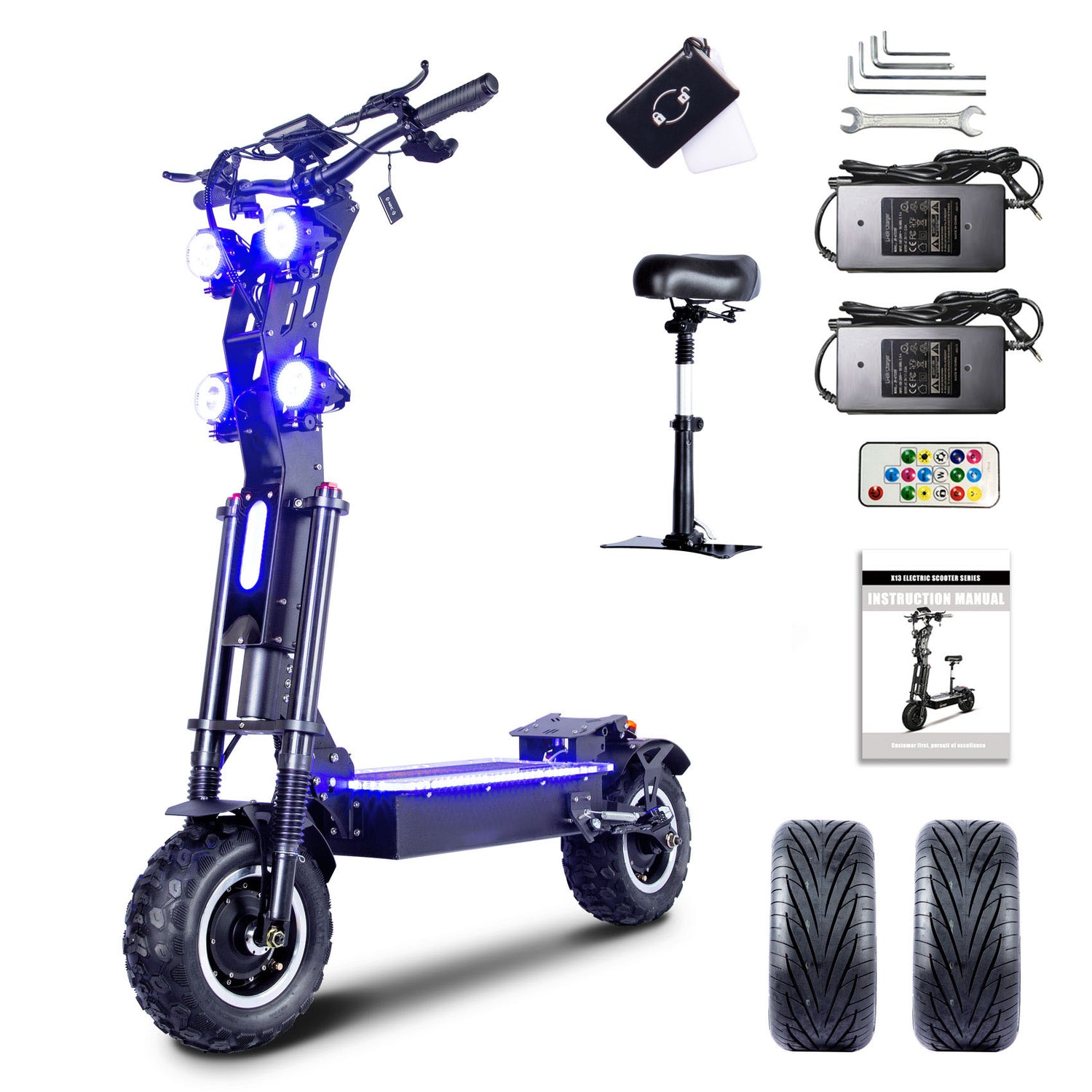


Best Off-Road Electric Scooter for Adults: The Complete 2026 Buyer's Guide
Choosing the best off-road electric scooter for adults isn't about picking whatever has the biggest number on the spec sheet — it's about matching the right machine to your terrain, your body, and how you actually ride. Trails, hills, and private property all demand things a standard city scooter simply can't deliver: serious torque, real suspension, rugged tires, and a frame built to absorb punishment.
The good news is that 2026's off-road scooters have borrowed heavily from mountain bikes and off-road motorcycles — dual suspension, high-torque hub motors, wide pneumatic tires, and reinforced alloy frames are now standard at the capable end of the market. The challenge is knowing which specs genuinely matter for your needs, and which are just marketing. This guide walks you through every decision — motor power, tires, suspension, range, hill-climbing, water resistance, weight capacity, brakes, and safety — so you can choose with confidence rather than guesswork.

Whether you're tackling gravel paths, climbing steep private land, or exploring backcountry trails, by the end you'll know exactly what to look for in the best off-road electric scooter for your adventures.
The Short Answer
The best off-road electric scooter for adults pairs high-torque motors (dual-motor setups for serious terrain), 10-inch-or-larger pneumatic off-road tires, dual front-and-rear suspension, strong disc or hydraulic brakes, and a UL-certified battery sized for real range. But "best" depends on your use case: light gravel and gentle hills need far less power than aggressive trails or steep climbs. Match the machine to your terrain, your weight, and your local laws — bigger isn't automatically better.
Below, we break down each factor so you can build the right spec for your needs.
What Makes a Scooter "Off-Road"?
Most electric scooters are built exclusively for smooth, paved surfaces. An off-road (all-terrain) scooter is engineered differently — purpose-built to handle dirt, gravel, grass, and uneven ground without sacrificing comfort or control. The difference comes down to four core components:
- Motor torque: High-torque (often dual) motors for climbing and acceleration on loose surfaces.
- Suspension design: Dual front-and-rear suspension that absorbs impact before it reaches you.
- Tire construction: Wide pneumatic or heavy-duty tires, typically 10 inches or larger, often with knobby tread.
- Frame rigidity: Reinforced steel or aviation-grade alloy that absorbs impact rather than transferring it to your feet.
A standard scooter pushed onto rough terrain will be uncomfortable, hard to control, and quick to wear out. A true off-road machine is built from the ground up for it.
Motor Power: Match It to Your Terrain
Motor power is the single biggest factor in off-road capability — but more isn't always better. Match it to how demanding your terrain actually is.
| Your Terrain | Motor Power | What It Handles |
|---|---|---|
| Light off-road | 250W–500W | Packed gravel, gentle hills, mixed pavement |
| All-terrain / moderate | 1000W–2000W | Dirt trails, moderate hills, varied surfaces |
| Aggressive / steep | 2000W–3000W+ (dual motor) | Steep sustained climbs, rough trails, heavy loads |
Look beyond top speed: Top speed gets the headlines, but for off-road, torque and rated hill-climbing grade (often expressed in degrees or %) matter far more — they reflect real climbing and acceleration ability on loose surfaces. A scooter rated to climb 20–30%+ grades will handle serious hills; lighter models top out much lower. Remember that more power also means more weight and higher cost.
Tires: Your Only Contact With the Ground
Tires directly determine grip, comfort, and how well the scooter handles obstacles. Three things matter:
Size
Look for tires 10 inches or larger. Bigger tires roll over rocks, roots, and ruts more easily and deliver a smoother ride. Many capable off-road models use 10 to 11-inch tires.
Tread
Knobby or rugged tread patterns dramatically improve grip on dirt, sand, and gravel — essential for genuine off-road traction.
Pneumatic vs. Solid
Pneumatic (air-filled) tires give the best grip and cushioning but carry puncture risk; tubeless versions resist punctures and deflate slowly when damaged. Solid tires are flat-proof and maintenance-free but cushion less — so they pair best with strong dual suspension.
Suspension: Non-Negotiable Off-Road
Suspension cushions you from bumps, rocks, and uneven terrain — protecting both comfort and control. For anything beyond smooth packed surfaces, it's essential, not optional.
- Dual suspension (front + rear) is the gold standard for off-road, absorbing impacts at both ends.
- Spring, hydraulic, or air-hydraulic systems each absorb shock; hydraulic and air-hydraulic tend to handle bigger impacts more smoothly.
- Adjustable suspension lets you tune the ride to your weight and terrain.
Without adequate suspension, impacts transfer straight to your hands, feet, and joints — tiring and harder to control. Suspension matters even more if you choose solid tires.
Range, Battery & Charging
Off-road riding consumes more power than smooth-road cruising, so real-world range is always lower than the headline figure (which is usually measured under ideal "eco" conditions on flat ground).
- Realistic range: All-terrain riding typically yields a real-world range in the range of roughly 10–20 miles for mid-tier models, with high-capacity machines reaching considerably further. Hills, rider weight, and aggressive riding all reduce range.
- Battery safety: Insist on a UL-certified lithium-ion battery for fire and electrical safety — especially important given the large batteries off-road scooters carry.
- Smart BMS: A battery management system protects against overcharging and improves longevity.
Rule of thumb: Estimate your longest realistic ride, then choose a battery with meaningful headroom above it — off-road conditions will eat into the rated range faster than you expect.
Brakes, Build & Weight Capacity
Power means nothing without the ability to stop and the strength to carry you safely.
- Brakes: Off-road speeds demand strong stopping power. Dual disc or hydraulic brakes are the benchmark; some models add electronic braking systems for extra control.
- Frame: Reinforced steel or aviation-grade aluminum alloy absorbs impact and resists fatigue over rough use.
- Weight capacity: Check the maximum load rating and ensure it comfortably exceeds your weight (plus any gear). Capable off-road models commonly support 265–330 lbs or more.
- Water/dust resistance: An IP rating indicates protection against water and dust — valuable for trail and wet-grass riding.
Safety, Certification & the Law
Street-legal status — read this before buying: Many high-powered off-road electric scooters are not street legal, because they exceed the speed and power limits local laws set for road or sidewalk use. This is exactly why they're often intended for private property or designated off-road areas. Laws vary by country, state, and city and change over time, so check your local regulations and confirm where you're legally allowed to ride before you buy.
On the safety side, prioritize:
- UL 2272 certification (covers the e-scooter's electrical system) and a UL-certified battery.
- Strong braking (dual disc or hydraulic) and bright lighting for visibility.
- Protective gear: Helmet at minimum; gloves, knee/elbow pads for trail riding.
- A reputable seller that clearly states certifications and offers a warranty.
Quick Buyer's Checklist
- Motor matched to terrain — 250–500W light, 1000–2000W moderate, 2000W+ dual for aggressive
- Hill-climbing grade meets your steepest planned climb
- Tires 10"+ with off-road tread (pneumatic/tubeless preferred)
- Dual suspension front and rear
- Realistic range with headroom for your longest ride
- UL-certified battery + smart BMS
- Dual disc or hydraulic brakes
- Weight capacity comfortably above your weight + gear
- Local legality confirmed for where you'll ride
- Reputable seller with clear certifications and warranty
Final Thoughts: Match the Machine to the Mission
The best off-road electric scooter for adults isn't the most powerful or most expensive one — it's the one that matches your terrain, your weight, and how you ride. Light gravel and gentle hills are well served by a capable mid-power scooter; steep private land and aggressive trails demand serious dual-motor torque, dual suspension, and rugged tires. Get the core four right — motor, tires, suspension, frame — then layer on the range, brakes, capacity, and safety features your riding demands.
Above all, buy from a reputable seller with proper certifications and a warranty, and confirm where you're legally allowed to ride before you head out. Do that, and you'll have a machine that turns trails, hills, and open ground into pure adventure for years to come.
Ready to find your match? Explore our off-road electric scooter collection to see models built for every terrain, or browse the full range to compare specs and find the right fit for your adventures.
Frequently Asked Questions
What makes an electric scooter good for off-road use?
Four core areas separate off-road from city scooters: motor torque (often dual-motor for climbing and acceleration on loose surfaces), dual suspension (spring or hydraulic, to absorb rocks and ruts), wide tires (10"+ with knobby tread for grip), and a reinforced steel or alloy frame that absorbs impact. A genuine off-road scooter is purpose-built for dirt, gravel, grass, and uneven terrain, while a standard scooter is made only for smooth pavement and struggles or wears out quickly off-road.
How much motor power do I need?
It depends on terrain. Light off-road (packed gravel, gentle hills): 250–500W. Moderate all-terrain: 1000–2000W. Aggressive trails or steep sustained climbs: dual-motor setups from roughly 2000W to 3000W+. Look at torque and rated hill-climbing grade rather than top speed alone, since these reflect real off-road capability. More power means more weight and cost, so match the motor to your actual terrain rather than buying the most powerful by default.
Are off-road electric scooters street legal?
Often not, and it varies significantly by location. Many high-powered off-road scooters exceed the speed and power limits local laws set for road or sidewalk use, which is why they're frequently intended for private property, designated off-road trails, or private land where permitted. Rules differ by country, state, and city and change over time. Before buying or riding, check your local regulations and confirm where you're legally allowed to ride — riding a non-street-legal scooter on public roads can carry legal consequences.
What tires are best for off-road?
Look for tires at least 10 inches in diameter — larger tires roll over obstacles more easily and ride smoother. Knobby or rugged tread improves grip on dirt, sand, and gravel. Pneumatic (air-filled) tires give better grip and cushioning but carry puncture risk; tubeless versions resist punctures and deflate slowly. Solid tires are flat-proof and maintenance-free but cushion less, so they pair best with strong dual suspension. Many capable off-road scooters use 10–11-inch pneumatic or tubeless tires with off-road tread.
How important is suspension?
It's one of the most important off-road features. Suspension cushions you from bumps, rocks, and uneven terrain, protecting comfort and control. The best models use dual (front and rear) suspension — spring, hydraulic, or air-hydraulic, sometimes adjustable. Without it, impacts transfer straight to your hands, feet, and joints, making rough terrain uncomfortable and harder to control. Suspension matters even more with solid tires, which cushion less than pneumatic ones. For anything beyond smooth packed surfaces, dual suspension is essential.
What safety certifications should I look for?
Look for UL 2272 (covers the e-scooter's electrical system) and a UL-certified lithium-ion battery, which address fire and electrical safety — especially important given the large batteries off-road scooters carry. Beyond certification, prioritize strong braking (dual disc or hydraulic), bright lighting, and a smart battery management system (BMS) for safe charging. A reputable seller should clearly state certifications and provide a warranty, which also indicates build quality and support.


