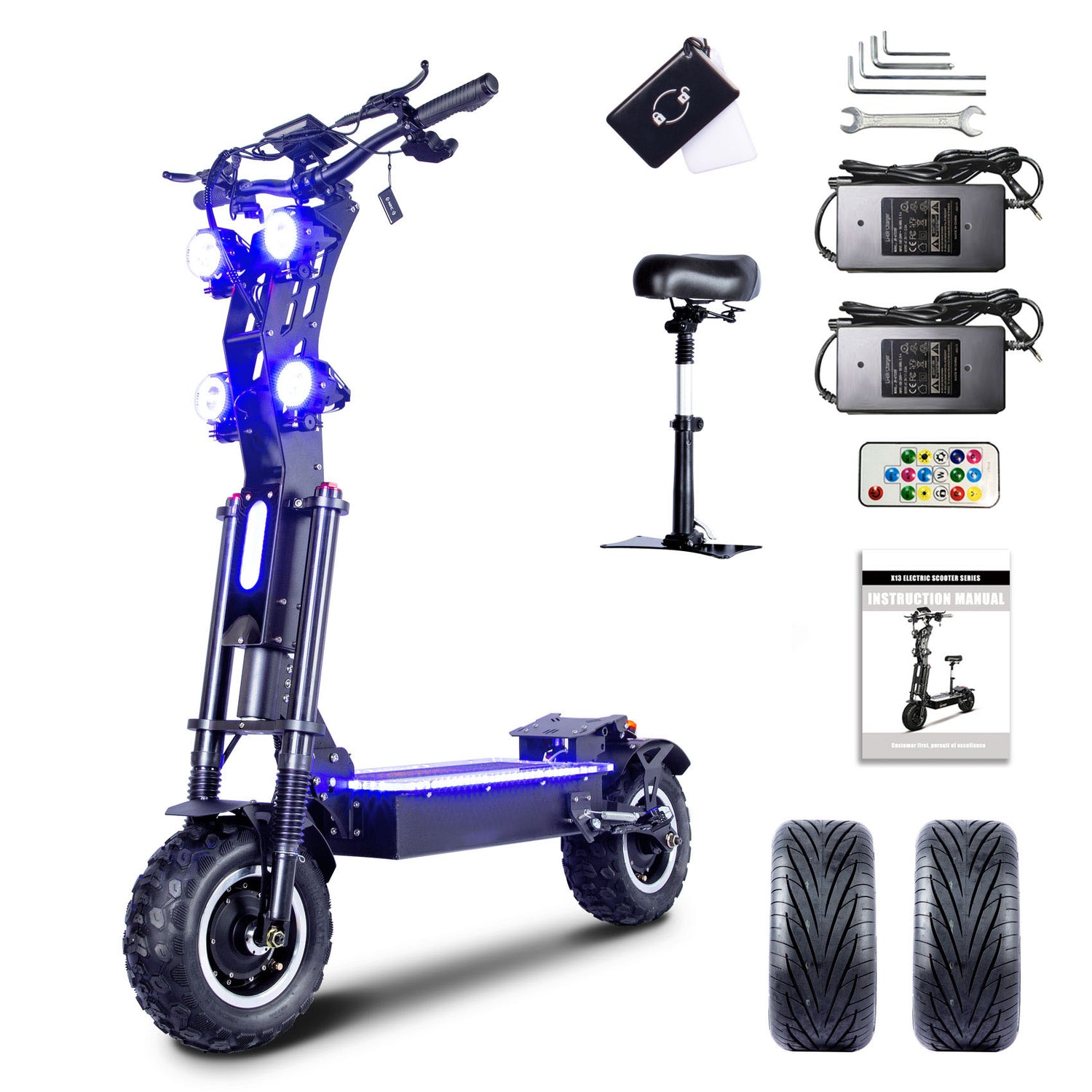


Off-Road Electric Scooters: What They Are, What They Conquer & Where You Can Ride
An off-road electric scooter is built for one thing: to go where ordinary scooters can't. Where a city scooter struggles, stalls, or wears out on the first gravel path, a genuine off-road machine turns dirt trails, hills, sand, and rough open ground into pure adventure. That capability is the entire point — and understanding what makes a scooter truly off-road, what terrain it can conquer, and where you're actually allowed to ride it is the key to enjoying one safely.
This guide is your complete introduction to off-road e-scooters. We'll explain exactly what separates an all-terrain scooter from a standard one, the technology that gives it its rugged capability, the specific terrain it can tackle, and — most importantly for riders in Germany, Austria, and across Europe — the rules on where you can legally and safely ride. Whether you're an adventure rider or just curious about these powerful machines, here's everything you need to know.
The Short Answer
An off-road electric scooter is a rugged, high-performance e-scooter purpose-built for rough terrain — dirt, gravel, grass, sand, and steep hills — not just smooth pavement. Four things make it off-road: powerful (often dual) motors, wide all-terrain tires, real suspension, and a reinforced frame. Together they conquer terrain a city scooter can't. But power comes with responsibility: high-power off-road scooters generally aren't legal on public roads in Germany and much of Europe, so they're for private property and recreational off-road use — always ride where it's legal and safe.
What Makes a Scooter "Off-Road"?
The term "off-road electric scooter" gets used loosely, so let's be precise. A genuine off-road scooter isn't just a city scooter with chunkier tires — it's a fundamentally tougher machine engineered to absorb impact, grip loose surfaces, and deliver the power needed to climb and accelerate where there's no smooth tarmac. Four core elements define it:
1. Powerful Motors (often dual-motor)
Off-road riding demands torque — to climb hills, push through grass or sand, and accelerate on loose ground. That's why serious off-road scooters often use dual-motor systems. HWWH's performance models, for example, run dual-motor setups built for steep gradients (climbing ability up to around 40°) and demanding surfaces.
2. Wide All-Terrain Tires
Tires are your only contact with the ground. Off-road scooters use wide, knobby all-terrain tires (often 11–14 inches on bigger models) for grip on dirt, gravel, and sand. Tubeless, puncture-resistant designs handle rough ground far better than the slim tires of a city scooter.
3. Real Suspension
Suspension is non-negotiable off-road. Spring and hydraulic suspension (HWWH models use hydraulic + spring systems) absorbs rocks, roots, and ruts, keeping the tires in contact with the ground for control — and saving your body from every bump.
4. Reinforced Frame & Strong Brakes
A reinforced steel or aluminum-alloy frame absorbs impact and lasts, while powerful hydraulic/oil disc brakes (and electronic braking systems) give the stopping power high speeds and steep descents demand. High weight capacity and ground clearance round out a true off-road build.
Take away any one of these and you have a scooter that will struggle — or quickly break — off the pavement. Together, they're what let an off-road machine do what it does. You can see how these elements come together across HWWH's off-road electric scooter collection.
What Terrain Can an Off-Road Electric Scooter Conquer?
This is where off-road scooters earn their name. With the right combination of power, tires, and suspension, a capable all-terrain e-scooter can take on a remarkable range of surfaces:
⛰️ Dirt & Forest Trails
The classic off-road environment. Knobby tires bite into packed dirt while suspension smooths out roots and ruts, making winding trails a thrill rather than a jolt-fest.
🪨 Gravel & Loose Stone
Loose surfaces that make standard scooters slip and skid. Wide all-terrain tires and dual-motor traction keep an off-road scooter planted and in control.
🌾 Grass & Fields
Soft, uneven ground that saps power from weak motors. Torquey dual motors push through grass and open fields with ease.
🏖️ Hard-Packed Sand & Beaches
Sand is demanding, but wide tires and strong motors let capable off-road scooters handle hard-packed sand and beach paths (loose, deep sand remains tough for any wheeled vehicle).
⬆️ Steep Hills & Inclines
Climbing is where dual-motor power truly shines — many performance models manage gradients up to around 40°, conquering hills that would stall a single-motor city scooter.
💧 Mud & Wet Ground (within reason)
With grippy tires and water-resistant build, off-road scooters handle damp trails and light mud — though deep mud and water crossings should always be approached with caution.
Capability depends on the machine: Exactly how much terrain a scooter can conquer depends on its motor power, tire size, suspension, ground clearance, and weight capacity. A higher-spec model like a dual-motor 10,000W build with 13–14" all-terrain tires handles far more than an entry-level model — so match the machine to the terrain you actually plan to ride.
Off-Road vs. City Electric Scooters
If you're wondering whether you really need an off-road scooter, this comparison makes the difference clear:
| Feature | City / Standard Scooter | Off-Road Electric Scooter |
|---|---|---|
| Best surface | Smooth pavement only | Dirt, gravel, grass, sand, hills |
| Motor | Single, lower power | Often dual-motor, high torque |
| Tires | Slim, smooth | Wide, knobby, all-terrain |
| Suspension | Minimal or none | Spring / hydraulic, robust |
| Frame | Lightweight | Reinforced, impact-resistant |
| Climbing | Gentle slopes only | Steep gradients (up to ~40°) |
| Typical use | Road-legal commuting | Private land / off-road recreation |
The takeaway: a city scooter is made for road-legal commuting on smooth surfaces, while an off-road scooter is a powerful recreational machine built for rough terrain. They're different tools for different jobs — and, as we'll cover next, different rules.
Where Can You Legally Ride? (The Crucial Part)
This is the single most important thing to understand before riding a powerful off-road electric scooter — especially in Germany, Austria, and across Europe.
High-power, high-speed off-road scooters generally cannot be ridden on public roads, paths, or cycle lanes. Road-legal e-scooters in Germany must comply with strict regulations (the eKFV rules), including a 20 km/h speed limit and a requirement for type approval (ABE) and insurance. Most powerful off-road scooters far exceed these limits and do not carry road approval — which means they are intended for private property and recreational off-road use only.
Ride responsibly and legally: Only ride a powerful off-road scooter on private land (with the owner's permission) or in designated, legal off-road areas. Do not ride it on public streets, sidewalks, or bike paths where it isn't permitted. Laws vary by country and region and can change — always confirm the current rules where you are before riding. When in doubt, treat your off-road scooter as a private-land recreational vehicle, not a public-road commuter.
This isn't a limitation on the fun — it's the framework for enjoying these machines responsibly. Plenty of private land, trails, and designated areas exist for off-road adventure. If you need a scooter for legal road commuting instead, look for a road-legal, speed-compliant model rather than a high-power off-road build. HWWH's broader electric scooter range includes options for different needs.
Riding Off-Road Safely
Off-road scooters are powerful, and that power deserves respect. A few essentials keep your adventures safe:
- Always wear a helmet — and ideally gloves, knee and elbow protection, and sturdy footwear. Off-road speeds and surfaces make protective gear essential.
- Start slow on new terrain. Learn how the scooter behaves on each surface before pushing the pace.
- Ride within your skill level. These machines are capable of high speeds — build up gradually.
- Check your scooter before each ride. Tires, brakes, suspension, and battery should all be in good condition.
- Keep both hands on the bars and stay alert to changing terrain, obstacles, and other people.
- Buy from a reputable seller with proper certification, a warranty, and genuine parts — quality and support matter for safety.
Gear up properly: The faster and rougher you ride, the more your safety gear matters. A good helmet is the absolute minimum; full protective gear is strongly recommended for genuine off-road riding.
Choosing the Right Off-Road Scooter for Your Terrain
Once you understand what off-road scooters can do, matching one to your needs is straightforward. Think about the terrain you'll actually ride and the capability it demands:
- Light trails & mixed surfaces: A capable single- or dual-motor model with all-terrain tires and suspension handles gravel paths and packed trails well.
- Steep hills & demanding terrain: Prioritize dual-motor power and strong climbing ability for hills, sand, and rough ground.
- Long off-road adventures: Look for a large battery and long range (HWWH performance models offer up to ~100–130 km range) so distance doesn't cut your ride short.
- Rider size & cargo: Check the weight capacity — robust off-road models often support up to 200 kg.
Browse and compare specs across the off-road scooter lineup to find a model matched to your terrain, or explore the high-performance range if outright power is your priority.
Conclusion: Built to Conquer the Terrain — Ridden Responsibly
An off-road electric scooter is a genuinely different machine from a city scooter: powerful dual motors, wide all-terrain tires, real suspension, and a reinforced frame combine to conquer dirt, gravel, grass, sand, and steep hills that would defeat an ordinary scooter. That rugged capability is what makes off-road riding such an adventure.
But with that power comes responsibility. High-power off-road scooters are generally for private property and recreational off-road use — not public roads in Germany, Austria, and much of Europe — so always ride where it's legal and safe, gear up properly, and respect both the machine and the terrain. Do that, and an off-road scooter rewards you with adventure for years to come.
Ready to find a machine built for your terrain? Explore the HWWH off-road electric scooter collection, or browse all HWWH scooters to compare models and find your perfect ride.
Frequently Asked Questions
What is an off-road electric scooter?
An off-road electric scooter is a rugged, high-performance e-scooter purpose-built to handle rough, uneven terrain — dirt trails, gravel, grass, sand, and steep hills — rather than only smooth city pavement. Four things separate it from a standard scooter: powerful motors (often dual-motor for torque and climbing), wide all-terrain tires with grippy tread for traction on loose surfaces, real suspension (spring and/or hydraulic) to absorb rocks and ruts, and a reinforced frame built to take impact. Together, these let it conquer terrain that would stop or quickly wear out an ordinary city scooter.
What terrain can an off-road electric scooter handle?
A capable off-road scooter handles dirt and forest trails, gravel and loose stone, grass and fields, hard-packed sand and beaches, light mud, and steep inclines — many models climb gradients up to around 40° thanks to dual-motor torque. Wide knobby tires provide grip, suspension absorbs the bumps, and a strong frame handles impact. Exact capability depends on the scooter's motor power, tire size, suspension, and ground clearance, but a genuine off-road model is designed for varied, demanding terrain a standard pavement scooter can't manage safely.
Can you ride an off-road electric scooter on public roads in Germany?
This is the most important point for riders in Germany and Austria. Powerful off-road and high-speed scooters generally cannot be ridden on public roads, paths, or cycle lanes, because they exceed the strict limits for road-legal e-scooters (in Germany, road-approved e-scooters must meet eKFV rules, including a 20 km/h limit and an ABE/insurance requirement). Most high-power off-road scooters lack this approval and are intended for private property and recreational off-road use only, with permission and in safe areas. Always confirm current local laws and ride only where you're legally allowed.
What features make an electric scooter good off-road?
Four core areas. Motor: dual-motor setups deliver torque for climbing and acceleration on loose surfaces. Tires: wide, knobby all-terrain tires (often 10"+) provide grip and absorb shock; tubeless designs resist punctures. Suspension: spring, hydraulic, or combined suspension absorbs rocks, roots, and ruts and keeps wheels grounded. Frame and build: a reinforced steel or alloy frame, strong hydraulic or oil disc brakes, good ground clearance, and high weight capacity ensure durability and control. Strong lighting and water resistance help too. Together, these let a scooter perform safely off the pavement.
Are off-road electric scooters safe to ride?
Yes, when you respect their power, the terrain, and the rules. Safety starts with protective gear — always a helmet, and ideally gloves, knee/elbow protection, and sturdy footwear, given off-road speeds and surfaces. Ride within your skill level, start slowly on new terrain, keep both hands on the bars, and check brakes, tires, and suspension before each ride. Crucially, only ride where it's legal and safe — on private property or designated off-road areas, not public roads where these scooters aren't permitted. Buying from a reputable seller with certification and a warranty also matters. Respect the machine and the rules, and off-road riding is a thrilling, safe adventure.


